Showing posts with label Status Quo. Show all posts

Tuesday, 15 June 2010

New AD says WVU wants to keep 'status quo'

West Virginia University needs to be savvy when addressing potential conference realignment scenarios, new athletic director Oliver Luck said Monday.

Luck said he would like to see the Big East continue in its current state, which includes eight members in football and 16 in basketball.

"I certainly think it's safe to say that we'd love to see the Status Quo continue, but like every other university, I think we need to be smart, strategic and try to figure out if X, Y and Z happened, what are our alternatives," Luck said. "We are talking to a lot of folks to make sure we do have potential opportunities should certain contingencies take place."

Big 12 members Colorado and Nebraska have announced their departures for the Pac-10 and Big Ten, respectively. Administrators at Texas and Oklahoma plan to hold meetings this week to determine their conference futures.

Luck said WVU's location in the East and its popularity on network television for basketball and football games makes the university an attraction for potential suitors.

"Obviously it's a challenging time within intercollegiate athletics given all the talk of conference realignment," Luck said. "I think our university has a tremendous opportunity."

WVU President James Clements hired Luck last week and introduced him at the news conference in a building attached to WVU's football stadium that opened in Morgantown in 1980, Luck's junior season. He ranks fourth on the school's all-time passing list and led WVU to a Peach Bowl win over Florida in his final game.

The 50-year-old Luck, who was president of Major League Soccer's Houston Dynamo and served as CEO of NFL Europe, will replace the retiring Ed Pastilong on July 1. Before taking the job, Luck stepped down from the WVU Board of Governors where he served for two years.


Tuesday, 6 April 2010

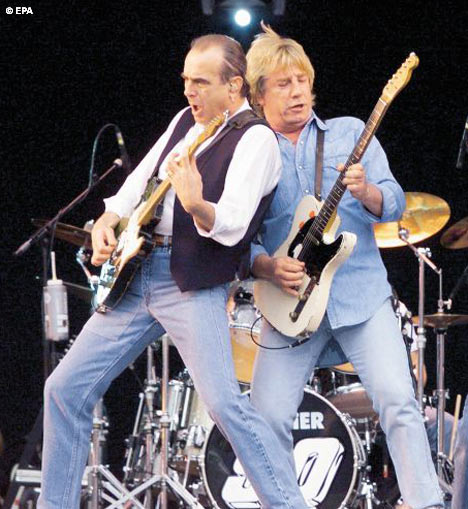
"Hardest Working Band for the Year 2009".


Status Quo have been recognised as the hardest-working band in the British music industry.

The Performing Rights Society list also included Cliff Richard And The Shadows, Take That, Coldplay and Kings Of Leon, who took the second, third, fourth and fifth spots respectively, according to BBC News.

The list was compiled based on the number of fans bands performed to in the UK during 2009.Status Quo played to 250,000 people at 27 arenas, putting them at the top of the list.

Frontman Francis Rossi said: "Performing in front of thousands of fans is the ultimate experience for any band.

Tuesday, 16 March 2010

Status Quo receive OBEs at Buckingham Palace

Status Quo rockers Francis Rossi and Rick Parfitt have described being appointed OBEs as the most exceptional moment of their musical careers.
The pair were given the honour for their services to music and charity in the Queen's New Year Honours list.
"It's wonderful that we have been recognised for what we've done," Parfitt said.
The band, whose songs include Rockin' All Over The World, first had a hit in 1968 with Pictures Of Matchstick Men.
"This is the most exceptional moment of our careers - there's no two ways about it," Rossi said.
"Live Aid was contrastingly very different and important, and there was a great euphoric feeling on the day, but nothing can make you forget this.

Sunday, 27 September 2009

Status quo on CTBT India maintains


The controversy regarding Comprehensive Nuclear Test Ban Treaty (CTBT) refuses to die down. The External Affairs Minister SM Krishna in a clear cut view stated that the country has taken a “principled “ stand on the CTBT and hardly there is any scope on the CTBT unless there is tangible scope where other countries can also gig significant changes in their stances on this contentious issue nothing is going to happen.
This is announced in the backdrop of a high level conference on disarmament on Thursday, addressed by UN General Secretary Ban Ki Moon, asked India and some eight other countries to ratify the agreement so that it comes into force. But India likely does not endorse unless it universally addresses the main concerns. “India has taken a position and we don’t look any reason for changing our stand,” Krishna told the media persons. He added, “We have taken a principled stand and so the question of India revsisiting it stands depends on a number of other developments that would address our concerns”.
Before the press conferences, Ban-Ki-Moon said, “the CTBT is a frequency building block for a free world of nuclear weapons.” He added, “By establishing a global norm against testing, the CTBT has made a significant contribution to the world community’s attempts to prevent the proliferation of nuclear weapons and to promote nuclear disarmament"

Thursday, 24 September 2009

Simpson challenges status quo in community address


President John B. Simpson today rallied community support for the UB 2020 strategic plan, urging an end to the status quo hindering UB’s ability to help revitalize the regional economy and become one of the nation’s premier public research universities.
“We can either choose to maintain the status quo, or we can choose to change our path,” Simpson told an audience of about 500 people attending his fourth annual community address held in historic Asbury Hall in downtown Buffalo. “We either let Albany continue to argue that our universities are ‘good enough,’ or we can recognize and nourish our universities as the catalysts for New York State to regain its position as a fully competitive player in the 21st century global-knowledge economy.”
Choosing the better path will shape the way Western New York and the rest of New York State looks in the year 2020 and beyond, said Simpson. He expressed concern over continued budget cuts and the lack of a state strategy for higher education.
“Right now, our nation wants its universities more than ever,” Simpson said. “These institutions are the economic engines of the 21st century—much like the steel mills were to the manufacturing economy of the 20th century.”
The state must invest in its universities, not cut them, he said.
“We can choose the path that will lead to a city with a thriving urban core,” he said, “a city with a diverse and growing population of educated, talented people. A city that is recognized around the world as a home for world-class medical care and medical research. A city with a lively arts scene that attracts talent from all over the globe, and a community whose embrace of innovation makes it fertile ground for new business, vital partnerships, prosperous investments and fresh opportunities for all residents.
“Or we can choose a path that will lead to a very different kind of city,” he continued. “One where the population continues to decline, as young people leave to find work elsewhere. A place where a third of our residents are illiterate and half of our African-American men are unemployed. A community that has lost hope for its future. A community that struggles to get by and watches helplessly as new jobs go to regions that choose to build their economies around research universities.”
Policy stagnation and short-sighted budget cuts are taking a heavy toll on UB and on Western New York, Simpson said. He again called for passage of state policy reforms that would give UB the financial flexibility to fulfill the potential of UB 2020.
UB 2020 can serve as the catalyst for regional growth and lay the groundwork for a much different—and much better—future for the region, Simpson said. UB’s growth will fuel the growth of more than 10,000 new jobs in the region for people at all levels, and thousands more construction jobs, he said. The development of UB’s Downtown Campus will bring more than 13,000 people into the heart of Buffalo each day. This growth will expand commercial opportunities for minority- and women-owned businesses, “opening doors to talented people who have historically been shut out.”
By achieving UB 2020, the university would nearly double its annual economic impact on the region from $1.7 billion to $3.6 billion.
Simpson noted that the community is increasingly united behind UB 2020 and cited five things the university and community must do together to achieve the plan’s potential:
• UB must continue doing everything within its power to make good on the UB 2020 promise. “We will remain steadfast in our pursuit of excellence and unwavering in our commitment to this community.”
• The Western New York legislative delegation must continue its good work in Albany to secure the state investment and regulatory flexibility needed to achieve UB 2020. “We need the entire community to continue supporting their efforts,” Simpson said.
• Albany needs to create a coherent higher education policy—and provide the resources necessary for it to succeed. “These funds can come from direct New York State investments, or they can come from a rational tuition policy and from the savings that will result from no-cost changes to outdated regulations,” Simpson said.
• SUNY’s leaders need to work together on a strategic plan for the entire system, one that can do for New York State what UB 2020 can do for Buffalo. “We applaud our new chancellor, Nancy Zimpher, for her leadership in this direction and for the strong support she has already voiced for the kind of policy reforms we are seeking. We will work with her and our SUNY colleagues to achieve this important goal,” Simpson said.
• The Western New York community should continue its financial, political and moral support for UB. “We need you to continue spreading the word to your employees, your co-workers, your business partners, your neighbors and your legislators that UB 2020 is this region’s big idea and its best path toward economic recovery,” Simpson said.
“I believe this community is ready,” he added. “We have a never-say-die spirit. We should, because we’ve faced our share of adversity.”
Simpson’s community address will be broadcast on WNED's Thinkbright-TV at 7:30 p.m. on Oct. 4 and on Time Warner Cable Channel 22 (Government and Education Access Channel) at noon on Sundays, beginning Oct. 4.

Wednesday, 16 September 2009

HC orders status quo on ‘Eenadu’


The Madras High Court on Monday ordered status quo on a petition by Pyramid Saimira Productions International Ltd seeking to restrain Raaj Kamal Films International, Kamal Haasan and others from releasing 'Eenadu' in Telugu and Tamil.
In an affidavit, the production firm said he actor and others had entered into an agreement with the company in April last year for the joint venture production of 'Marmayogi' on a budget of Rs 100 crore.
The petitioner said the company had parted with a huge amount to the respondents, but they had not evinced any interest in the production of 'Marmayogi'.
The respondents had diverted the funds for the production of their picture 'Eenadu' and were attempting to release it. Thus, the terms and conditions of the MoU had been violated, according to the petitioner.
Justice G Rajasuria ordered status quo till September 16.

Thursday, 27 August 2009

Letter: Health care status quo not sustainable


As the consideration about health care reform heats up, it would be good to review some facts. About 50 million Americans, including many in our community, do not have health insurance, and many more are underinsured. Even more are hard aware that they can be dropped from insurance if they get sick or might not be wrapped because of some pre-existing condition.Other developed countries spend far less than our country on health care and have better outcomes such as durability and infant mortality rates.Many leaders, including executives at GM and other large corporations, as well as many politicians and most Americans, see the want for reform. The question is, can we agree to agree?Consensus is building for a authority that everyone carry health insurance while prohibiting insurance companies from selectively cherry-picking patients.Three quarters of Americans favor a Medicare like public option so that people have a choice between personal and public insurance. This public option has been endorsed by a number of cautious arrangment including the American Academy of Family Physicians, the American Medical Association, and the Mayo Clinic.Some assert that this is socialized medicine, but it is no more socialized than Medicare or veterans’ care. Some assert that it would create panels to agree if a person deserves to get care, but it would not. Some assert that reform would be too expensive, but with the way things are going now, we can’t afford NOT to change the system, and donation an option like Medicare to everyone is critical to including costs.When Medicare was passed in 1965, there were urgent predictions about socialism and death panels; once in place, Medicare has proven to be effective and popular. Can we expand it to cover more people? I think we can.Jim Deming,Tomah

Monday, 24 August 2009

The school year with status quo contract FWCS, FWEA agree to start it


Fort Wayne Community Schools and the Fort Wayne Education Association have accede to maintain a status quo contract for the next school year, which means there will be no major language changes in the contract and no changes in the salary schedule. Under state law, when a new contract is not established the existing contract remains in effect. FWCS and FWEA agreed to move forepart without bargaining a new contract for the 2009-10 school year. In June, the two sides adjourn bargaining as the state budget was still unclear. Leaders had hope that a clearer financial picture would emerge prior to the beginning of the school year, and they could return to negotiations. While more financial information is now available, FWCS officials plan a full analysis of the community's finances over the next few months. Until that is complete, both sides agreed there was little that could be accomplished in formal bargaining sessions. FWCS and FWEA will continue meeting regularly to discuss issues that arise throughout the year, including setting calendars for future school years. "We will continue to use our discussion process to have dialogue open so as issues arise there is a way to communicate with teachers," Superintendent Wendy Robinson said. "With so much remaining uncertain financially, this was the best consclusion we could reach at this point." FWEA President Al Jacquay said it makes sense to forgo negotiating this year and resume bargaining next of spring. "We're going to table this for right now and focus on the job of educating students," he said.

Sunday, 23 August 2009

Status Quo: Status Quo is not an option for cancer patients


As a cancer patient, I know that our nation's current health care system is broken and does not work for many people with cancer.
Too often, the high cost of health care keeps many cancer patients from being able to produce the lifesaving treatments they need. They can be forced to make tough choices such as delaying care, skipping medications or forgoing other household bills just to make ends meet. And if a cancer patient loses his or her job or is no longer able to work, it can be impossible to find reasonable insurance in the private individual market because of pre existing condition exclusions and excellent based on health status.
Cancer patients can experience all of the ambush of the current broken health care system. Which is why, if we can fix it for them, we can fix it for parctically anyone at risk of being diagnosed with a chronic disease. We need to focus on transforming the current system to one that places greater emphasis on preventing disease, provides quality, reasonable health insurance for all Americans and emphasizes the importance of supporting a patient's choice of life.
The good news is that the bills currently being argument by Congress represent a huge promotion for people fighting cancer.
In their current form, the bills guard that no one will be denied coverage or charged a higher premium because of pre existing medical conditions, place an addition accent on prevention and eliminate annual and lifetime dollar caps on benefits. These are enormous steps forward.
But the only way that we can benefit from this progress is if we keep the momentum going and call on Congress to pass health care reform legislation. At the same time, Congress wants to ensure that any reform includes reportage that is adequate and reasonable for people with cancer and other life threatening chronic diseases.
To action that, we want to make sure that insurance premiums are reasonable for everyone, that there is a reasonable limit on out of pocket costs to the patient and that the benefits are acceptable to treat a person with cancer.
Cancer patients across the country are digging deep into their savings and risking financial ruin to pay for lifesaving care. In Utah, 1 in 4 control people under the age of 65 live in households that spend more than 10 percent of their income on health care costs. This number added by 89 percent between 2000 and 2008.
High costs are forcing tough decisions upon families with cancer that no one should ever have to make. Nearly a third of all adults who have been diagnosed with cancer face difficulty paying for necessities such as food, housing, heat and other bills. No cancer patient should ever be pressured to make a decision between continuing their life or keeping their life savings.
We cannot abase death and suffering from cancer if the country does not improve access to quality, reasonable health care for all Americans. Cancer patients know too well the holes in our broken "sick care" system. The status quo is not an option for cancer patients and survivors who are struggling to allow the care they need. We need Congress to put aside partisan politics and act now, not later, on behalf of all of their constituents who have cancer or who could get cancer -- in other words, for all of us.
Iris Tolley is the lead volunteer for the American Cancer Society Cancer Action Network in Utah. She is also a terminal cancer patient and has exponent for cancer patients in Washington and at the Utah State Capitol. She lives in Nephi.